
By Wendy He – Silicone Baby Product Expert
Updated: Sep 04, 2026
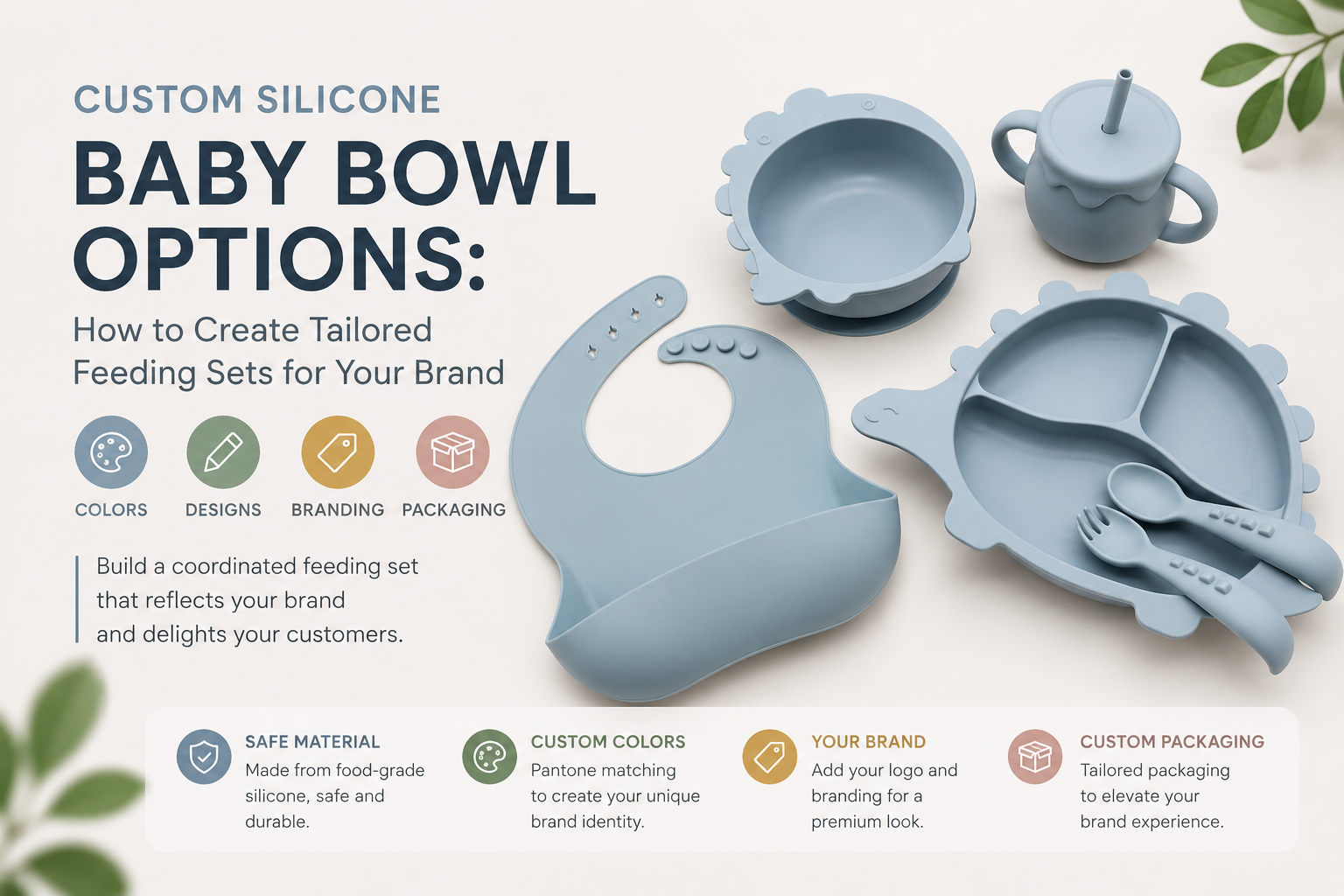
Custom silicone baby bowls can be adapted beyond color and logos. Brands can create coordinated feeding sets by customizing bowl design, colors, branding, packaging, and complementary products such as plates, cups, spoons, and bibs.
Key Takeaways
-
• Customization can cover the bowl's design, color, branding, packaging, and product combination.
- • A feeding set should be planned as one coordinated collection rather than several unrelated products.
- • Not every brand needs a completely new mold; the right customization level depends on the product concept and market.
- • Consistent colors, branding, product design, and packaging help create a stronger brand identity.
- • A clear product brief makes sample development faster and reduces unnecessary revisions.
Quick Answer
Brands can create tailored silicone baby feeding sets by customizing bowl design, silicone color, branding, packaging, and complementary products such as plates, cups, spoons, forks, and bibs. The best approach is to define the target customer and product collection first, then choose the appropriate level of customization—from private-label branding to full OEM/ODM development.
For baby brands, a silicone baby bowl does not have to be sold as a standalone feeding product. It can become the core of a coordinated feeding collection built around your brand identity, target customer, and retail positioning.
From bowl shape and silicone color to logos, complementary feeding products, and packaging, brands have multiple ways to create a differentiated product line. The key is not to customize everything, but to choose the options that provide meaningful value for your market.
What Can You Customize on a Silicone Baby Bowl?
The main customization areas are product structure, silicone color, branding, and packaging. The level of customization can range from simple private-label changes to a completely new product design.
Custom Bowl Shape and Structure
The bowl itself can be customized when your brand requires a specific appearance, size, or function.
Depending on the product concept, customization may include:
- • Bowl shape
- • Overall dimensions
- • Bowl depth
- • Handle design
- • Compartments
- • Base structure
For example, a brand may prefer a wider bowl for easier access during self-feeding, a deeper design for foods such as porridge, or a particular shape that matches its existing tableware collection.
However, structural changes are different from simple color or logo customization. A new shape or structure may require mold development, sample testing, and additional production planning.
For brands seeking simple customization, an existing bowl design may be more efficient. For brands that need a distinctive product, custom mold development can provide greater differentiation.
Custom Silicone Color
Color is one of the simplest ways to create a recognizable baby feeding collection.
Brands can select colors that match their existing visual identity or develop a dedicated palette for a new product line. Multiple colors can also be used across different products while maintaining a consistent collection.
For B2B projects, it is useful to confirm:
- • Target color
- • Pantone reference, if applicable
- • Number of colors
- • Color consistency across products
- • Color placement for multi-color designs
When a bowl is part of a larger feeding set, color consistency becomes especially important. A bowl, plate, cup, and bib should look like products from the same collection rather than unrelated items.
Custom Logo and Branding
Logo customization allows a standard or customized silicone baby bowl to become part of a private-label product line.
Depending on the product design and manufacturing process, brands may customize:
- • Logo placement
- • Logo size
- • Logo color
- • Branding method
The most important step is to approve the final logo position and appearance during sampling.
A logo that looks good on a digital design may appear different when applied to an actual silicone surface. Therefore, the physical sample should be used as the final reference before mass production.
Custom Packaging
Packaging is another important part of a branded feeding product.
Brands can develop packaging around their retail positioning, including:
- • Retail boxes
- • Kraft packaging
- • Bags
- • Product inserts
- • Labels
- • Barcodes
- • Gift-set packaging
If the bowl will be sold as part of a feeding set, the packaging should be designed around the complete set rather than the bowl alone.
This helps create a more consistent presentation across the product, packaging, and retail channel.
How to Build a Silicone Baby Feeding Set Around Your Brand?
The best feeding sets are planned as product collections, not simply as several baby feeding products placed in one package.
Start with the silicone baby bowl as the core product, then select complementary products according to your target customer and product positioning.
Start With the Core Product
Before selecting additional products, determine the role of the bowl within your collection.
Consider:
- • Who will use the product?
- • What feeding stage is it designed for?
- • Is it an everyday feeding product or part of a gift set?
- • What bowl size and capacity fit the intended use?
- • Does the bowl need a suction base, handles, or other features?
The answer will influence which products should be included in the final feeding set.
For example, an everyday feeding collection may prioritize practical combinations, while a premium gift collection may place greater emphasis on product variety and packaging.
Choose Complementary Feeding Products
Once the bowl is defined, brands can add products that naturally support the same feeding routine.
Common combinations include:
- • Silicone baby plate
- • Silicone baby cup
- • Silicone spoon and fork
- • Silicone baby bib
- • Feeding mat
Your existing silicone baby feeding set collection already uses this type of product combination, making it a natural reference for brands planning a complete feeding range.
The goal is not to include as many products as possible. Each additional product should have a clear role within the set.
Match the Set to Your Target Customer
Different markets may require different product combinations.
| Feeding Set Type | Possible Combination | Positioning |
|---|---|---|
| Basic Set | Bowl + Spoon | Simple entry-level offering |
| Everyday Set | Bowl + Plate + Spoon | Daily feeding |
| Complete Set | Bowl + Plate + Cup + Spoon | Full feeding solution |
| Gift Set | Feeding products + Custom Packaging | Gift and premium positioning |
For example, a new brand entering the market may begin with a smaller set to test customer demand. An established baby brand may prefer a broader collection that includes multiple tableware products.
The right feeding set is not necessarily the largest one. It is the one that best matches the customer's purchasing needs.
How Much Customization Does Your Brand Actually Need?
Not every brand needs a completely new mold. The appropriate customization level depends on your product positioning, differentiation strategy, budget, and expected production requirements.
Standard Product + Brand Customization
This is usually the simplest approach.
A brand can start with an existing product design and customize selected elements such as:
- • Color
- • Logo
- • Packaging
This approach is suitable for brands that want to launch quickly while maintaining their own visual identity.
It can also be useful when testing a new product category before investing in deeper product development.
Customized Product Collection
A more advanced approach is to create a coordinated collection using multiple existing or customized products.
For example:
Bowl + Plate + Cup + Utensils
can share:
- • Brand colors
- • Logo treatment
- • Similar design language
- • Coordinated packaging
This approach gives brands more differentiation without requiring every product to be completely redesigned.
It is particularly suitable for brands that want to build a recognizable baby feeding range rather than sell individual products.
Fully Custom OEM/ODM Development
Full OEM/ODM development is more suitable when a brand needs a product that is substantially different from existing designs.
This may involve:
- • New bowl shape
- • New structure
- • Custom compartments
- • Proprietary product concepts
- • New molds
- • Product development support
This level of customization requires more development work and should therefore begin with a clear product brief.
The goal of OEM/ODM is not simply to make a product look different. It should create a product that has a clear reason to exist for your target market.
Customization Level at a Glance
| Customization Level | Main Changes | Best For |
|---|---|---|
| Brand Customization | Color, logo, packaging | Private-label and new brands |
| Product Collection | Coordinated products and branding | Established product lines |
| OEM/ODM | Product structure and new design | Differentiated product concepts |
This gives buyers a practical way to decide how far they actually need to go with customization.
How to Create a Consistent Look Across Your Feeding Set?
A successful feeding set should look like one brand collection, not several unrelated products packaged together.
Brand Consistency Checklist
| Element | What to Keep Consistent |
|---|---|
| Color | Use the same brand color system across products |
| Logo | Keep logo treatment and placement consistent |
| Product Design | Use a related visual language across the collection |
| Packaging | Coordinate graphics, typography, and product presentation |
Keep Silicone Colors Consistent
If the bowl is soft beige, for example, the matching plate and cup should use a compatible color system.
For brands with multiple collections, a defined color palette can also make it easier to distinguish different product lines.
Keep Branding Consistent
The logo does not necessarily need to appear in exactly the same position on every product.
However, its overall treatment should feel consistent.
The important factors include:
- • Logo appearance
- • Scale
- • Color
- • Placement strategy
Coordinate Packaging
The packaging should visually connect the products inside.
A feeding set with coordinated colors and product design can lose its premium appearance if the packaging uses an unrelated visual style.
Design the Set as a Product Collection
Instead of designing each product independently, define the visual direction of the entire collection first, then apply it to individual products.
This makes future product expansion easier as well.
For example, if a brand later adds a snack cup or toddler plate, the new product can follow the same visual system instead of starting from zero.
What Should You Prepare Before Custom Sample Development?
Before requesting custom samples, brands should prepare a clear product brief.
A clear brief helps manufacturers understand the project and reduces unnecessary changes during sample development.
Product Requirements
Prepare the basic product information:
- • Product type
- • Bowl size
- • Capacity
- • Shape
- • Functional requirements
- • Feeding set configuration
You do not need to provide a fully engineered product before contacting an OEM/ODM manufacturer. However, the clearer your product concept is, the easier it is to discuss feasible solutions.
Packaging Requirements
Decide whether the product will be sold:
- • As an individual bowl
- • As a multi-piece feeding set
- • As a gift set
- • With retail packaging
- • With customized labels or barcodes
Packaging requirements should be considered before production rather than after the product has been finalized.
Target Market and Compliance
Tell the manufacturer where the product will be sold.
This matters because applicable requirements can vary by market and product use.
For products sold in the United States, children's products subject to applicable safety rules may require third-party testing and a Children's Product Certificate. The CPSC explains that the certificate is based on applicable children's product safety requirements and testing by a CPSC-accepted laboratory.
For products intended for food contact in the European Union, food-contact materials are subject to EU safety requirements, including the general framework under Regulation (EC) No 1935/2004.
The specific testing and documentation required should be confirmed for the final product, materials, intended use, and target market.
Sample Approval
Before mass production, review the physical sample against the agreed requirements.
Check:
- • Product dimensions
- • Shape
- • Color
- • Surface finish
- • Logo
- • Product combination
- • Packaging
The approved sample should serve as the physical reference for mass production.
Frequently Asked Questions About Custom Silicone Baby Feeding Sets
Can I customize a silicone baby bowl without changing the mold?
Yes. If the existing bowl design meets your structural requirements, brands may be able to customize elements such as color, logo, and packaging without developing a completely new mold.
Can I create a feeding set using existing silicone products?
Yes. Existing bowls, plates, cups, utensils, and bibs can be combined into a coordinated feeding set, depending on the supplier's available product range and packaging options.
What products can be combined with a silicone baby bowl?
Common complementary products include silicone plates, cups, spoons, forks, bibs, and feeding mats. The final combination should reflect the target customer and intended positioning of the set.
Do I need a new mold for a fully custom baby bowl?
Not necessarily. A new mold is generally associated with changes to the product's physical shape or structure. Color, logo, and packaging customization may be possible using an existing product design.
What is the difference between private label and OEM/ODM?
Private-label customization generally starts with an existing product and adapts elements such as branding, color, or packaging. OEM/ODM projects can involve deeper product development, including customized structures or new product concepts.
Can the entire feeding set use the same brand color?
Yes. Using a coordinated color system across bowls, plates, cups, utensils, and packaging can help create a more recognizable product collection. Multiple complementary colors can also be used when they fit the brand's visual identity.
Final Thoughts: Build a Feeding Set Around Your Brand
A custom silicone baby bowl can be the starting point for a much broader feeding collection.
The most effective approach is not to customize every possible element. Instead, start with your target customer and product positioning, then decide:
What should the bowl look like?
Which products should be included in the set?
How much customization does the brand actually need?
How should the products work together visually?
What needs to be confirmed before sampling?
For some brands, custom color, logo, and packaging may be enough to create a strong private-label product. Others may benefit from a coordinated product collection or a fully customized OEM/ODM design.
The right strategy is the one that creates meaningful differentiation while keeping the product practical to develop, manufacture, and sell.
Author Bio
Wendy He is a silicone baby product expert with extensive experience in baby feeding product development and OEM customization solutions. She specializes in food-grade silicone products, infant feeding solutions, and private label baby product manufacturing.
If you are in business,You may like
Create Your Custom Silicone Baby Feeding Set
Looking for a manufacturing partner for your next baby feeding collection?
Melikey supports OEM and ODM silicone baby product projects, including product customization, color matching, branding, packaging, sample development, and bulk production.
Post time: Sep-04-2026